There are Chinese projects on territories in J&K that belong to India: MEA
TL;DR Summary
- India’s Ministry of External Affairs (MEA) has confirmed the presence of Chinese infrastructure projects in territories within Jammu & Kashmir that India considers its own, currently under illegal occupation by China.
- The MEA reiterated India’s consistent position that these areas are integral parts of the country, thereby rejecting any legitimacy for China’s activities or territorial claims.
- This statement underscores the persistent and complex nature of the India-China border dispute, particularly concerning areas like Aksai Chin and the implications of projects like CPEC passing through Indian-claimed territories.
In-Depth Report
MEA Confirms Chinese Activities in Indian-Claimed Territory
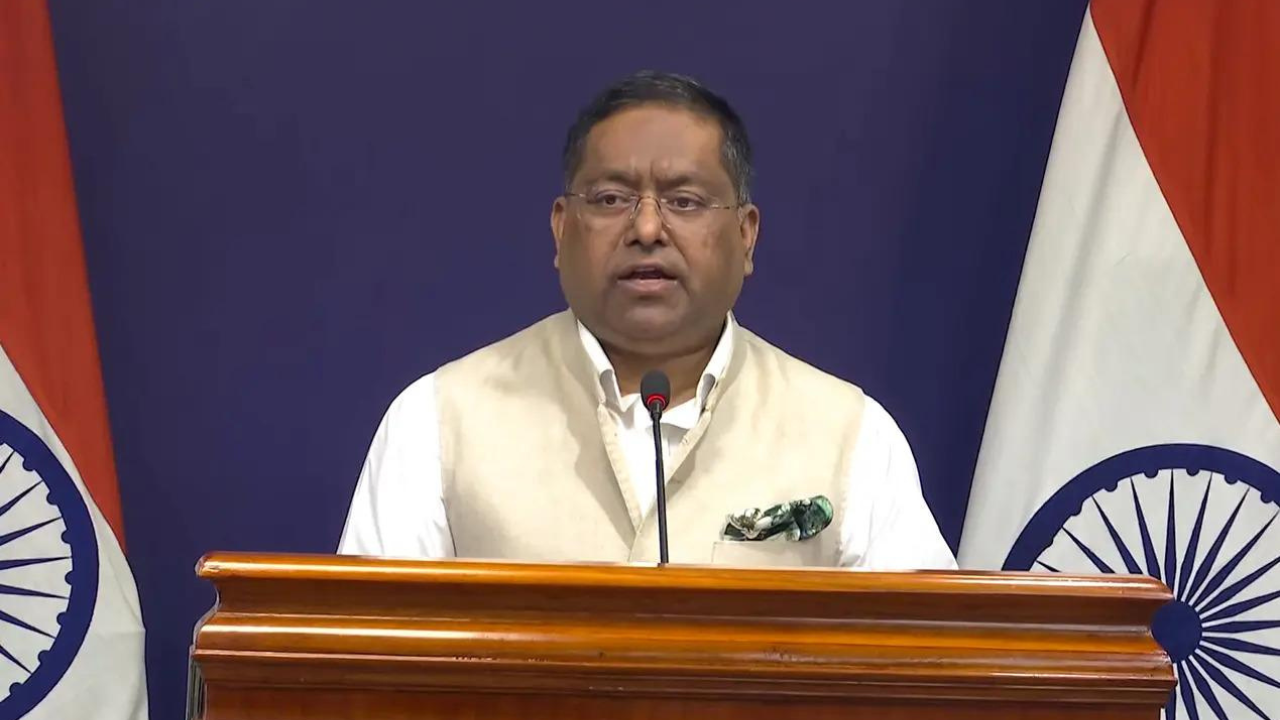
New Delhi, India – The Ministry of External Affairs (MEA) has once again brought into sharp focus the contentious issue of Chinese activities in Indian-claimed territories within Jammu & Kashmir. In a recent statement, the MEA confirmed that China is indeed carrying out infrastructure projects in areas that are an integral part of India but are currently under illegal occupation by Beijing. This assertion from the Indian government, while consistent with its long-held stance, serves as a fresh reminder of the deeply entrenched territorial disputes that continue to plague India-China relations. The spokesperson for the MEA reiterated India’s clear and unambiguous position, stating that New Delhi has consistently conveyed its concerns to the Chinese side regarding any development activities in these unlawfully occupied territories.
Unpacking the ‘Projects’: Aksai Chin and CPEC
While the MEA’s statement did not specify the exact nature or location of these projects, it is widely understood to encompass development activities both in the Aksai Chin region, occupied by China since the 1962 war, and potentially those associated with the China-Pakistan Economic Corridor (CPEC) passing through parts of Pakistan-Occupied Kashmir (PoK), which India also considers its integral territory. In Aksai Chin, reports have indicated a significant build-up of military and dual-use infrastructure, including advanced road networks, airfields, and logistical bases, designed to enhance China’s strategic depth and operational capabilities along the Line of Actual Control (LAC). These projects are viewed by India as direct infringements on its sovereignty and a unilateral attempt to alter the status quo in disputed regions.
India’s Unwavering Stance and Diplomatic Recourse
The Indian government has maintained an unwavering position on its territorial integrity, consistently asserting that the entire Union Territory of Jammu & Kashmir and Ladakh is an integral part of India. The MEA’s latest statement reaffirms this principle, underscoring that any activities undertaken by other nations in these regions are without legal basis and are vehemently opposed by India. Diplomatically, India has utilized various bilateral channels and international forums to register its protests and make its position clear. While direct engagement on these specific projects has often met with Chinese dismissiveness, India’s public stance is crucial for asserting its claims and signaling its resolve to defend its sovereign rights. The issue remains a significant irritant in an already strained bilateral relationship, particularly in the aftermath of recent military stand-offs along the LAC.
Geopolitical Implications and Regional Stability
The confirmation of Chinese projects in Indian-claimed territories adds another layer of complexity to the already fragile geopolitical landscape of the Himalayas. Such developments have profound implications for regional stability, potentially fueling an arms race and increasing the risk of future confrontations. For India, China’s assertive infrastructure drive is seen as part of a larger strategy to consolidate its territorial gains and project power across the region. This not only challenges India’s security interests but also impacts the broader balance of power in South Asia. The international community, while often maintaining a cautious distance from bilateral territorial disputes, closely watches these developments, recognizing their potential to destabilize one of the world’s most populous and strategically vital regions.
Background & Context
The Legacy of 1962 and the Aksai Chin Dispute
The territorial dispute over Aksai Chin is a direct legacy of the 1962 Sino-Indian War. Prior to the conflict, India claimed Aksai Chin based on historical maps and colonial-era boundaries, while China disputed this, asserting its own historical claims to the barren high-altitude plateau. The war resulted in China gaining control over a significant portion of Aksai Chin, which it has since administered as part of its Xinjiang Uyghur Autonomous Region and Tibet Autonomous Region. India has never officially recognized this occupation and continues to assert its sovereignty over the entire region. The Line of Actual Control (LAC) that emerged from the conflict, though undemarcated, largely follows the lines of Chinese control, making Aksai Chin a permanent flashpoint in India-China relations.
The CPEC Controversy and Gilgit-Baltistan
Another critical dimension to India’s concerns regarding Chinese projects in its claimed territories relates to the China-Pakistan Economic Corridor (CPEC). This flagship project of China’s Belt and Road Initiative (BRI) involves a network of roads, railways, and energy pipelines connecting China’s Xinjiang province to Pakistan’s Gwadar Port on the Arabian Sea. A significant portion of CPEC traverses through Gilgit-Baltistan, a region in Pakistan-Occupied Kashmir (PoK). India unequivocally claims Gilgit-Baltistan as an integral part of its territory, viewing Pakistan’s administration of the region as illegal. Consequently, any Chinese infrastructure development in Gilgit-Baltistan, under the ambit of CPEC, is seen by India as a direct violation of its sovereignty and territorial integrity, leading to strong diplomatic protests against both China and Pakistan.
Persistent Border Tensions and Military Stand-offs
The issue of Chinese projects in disputed territories is inextricably linked to the broader and long-standing India-China border dispute, which spans over 3,488 kilometers along the LAC. The lack of a mutually agreed and demarcated border has led to frequent transgressions and military stand-offs, the most significant recent example being the Galwan Valley clash in June 2020. These incidents highlight the fragility of peace along the border and the deep mistrust that characterizes the bilateral relationship. China’s continued infrastructure development, both civilian and military, in these sensitive areas is perceived by India as an attempt to bolster its claims and enhance its strategic advantage, further complicating any efforts towards de-escalation and a lasting resolution of the border issue.
Why It Matters (Impact Analysis)
Sovereignty and International Law
At its core, India’s strong reaction to Chinese projects in its claimed territories is a matter of sovereignty and adherence to international law. By consistently asserting its claims and protesting against foreign activities, India reinforces its legal and historical rights over these regions. A failure to do so could be interpreted as tacit acceptance, weakening India’s position on the global stage. This also sends a clear message to other nations about India’s resolve to protect its territorial integrity, serving as a deterrent against similar encroachments elsewhere. The ongoing dispute highlights the challenges in upholding international norms when powerful states engage in unilateral actions in disputed zones.
Regional Geopolitics and Security Dilemma
The presence of Chinese infrastructure in Indian-claimed areas significantly alters the regional geopolitical landscape. These projects, especially those with military implications, directly impact India’s security calculations and defense preparedness. They contribute to a security dilemma, compelling India to invest more heavily in its own border infrastructure and military capabilities, potentially leading to an arms race in the Himalayas. Furthermore, China’s increasing footprint in PoK via CPEC raises concerns about a potential two-front security challenge for India, adding to existing tensions with Pakistan and creating a complex web of alliances and rivalries in South Asia.
Economic Implications and Development Trajectories
While primarily a strategic and sovereignty issue, the Chinese projects also carry economic implications. For China, CPEC is a vital component of its Belt and Road Initiative, promising economic benefits and enhanced connectivity. However, for India, CPEC’s passage through PoK is not only a sovereignty violation but also raises concerns about unchecked Chinese influence in its immediate neighborhood, potentially impacting regional trade routes and India’s own development projects. The ongoing border tensions and infrastructure race divert significant resources from social and economic development into defense spending, ultimately affecting the welfare and progress of both nations and the wider region.
Key Takeaways
- The persistence of China’s infrastructure development in disputed/claimed territories underscores a fundamental disagreement on sovereignty that remains a primary impediment to normalized India-China relations and regional stability.
- India’s firm diplomatic stance, while crucial for asserting its claims and territorial integrity, signals continued vigilance and the potential for a more robust response should such activities intensify or directly threaten Indian security interests.