Ken-Betwa Interlinking Project: Tribal Discontent Fuels Protests from Chita Andolan to Jal Satyagrahas in Madhya Pradesh
TL;DR Summary
- The ambitious Ken-Betwa river interlinking project faces significant opposition from tribal communities in Madhya Pradesh due to profound concerns over displacement and environmental impact.
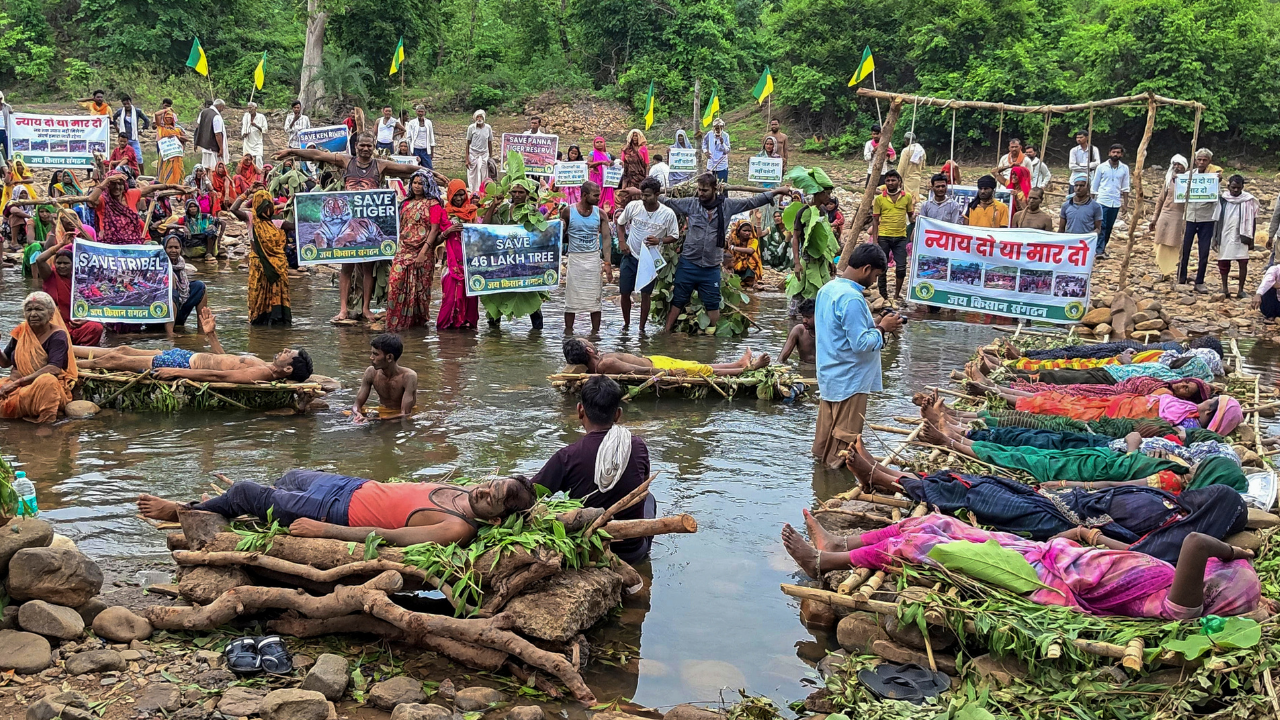
- Protests have manifested in various forms, ranging from the symbolic ‘Chita Andolan’ to sustained ‘Jal Satyagrahas’ where participants immerse themselves in water to highlight their plight.
- These movements underscore the growing tension between large-scale infrastructure development objectives and the fundamental rights and traditional livelihoods of indigenous populations.
In-Depth Report
Escalating Tribal Resistance Against the Ken-Betwa Project
The proposed Ken-Betwa river interlinking project, envisioned as a solution to water scarcity in the Bundelkhand region, is encountering formidable resistance from tribal communities in Madhya Pradesh. What began as scattered grievances has escalated into organised and sustained protests, notably including the ‘Chita Andolan’ and several ‘Jal Satyagrahas’, articulating a deep-seated apprehension regarding the project’s socio-economic and environmental repercussions. The dissenters contend that the promised benefits of irrigation and power generation come at an unacceptable cost: the forfeiture of ancestral lands, disruption of traditional livelihoods, and irreversible damage to critical ecosystems.
The Significance of ‘Chita Andolan’ and ‘Jal Satyagrahas’
The ‘Chita Andolan’, a term indicative of a profound symbolic protest, has historically represented movements of extreme distress or collective agitation among affected communities. In the context of the Ken-Betwa project, it signifies an early phase or a continuous thread of resistance expressing the tribals’ existential concerns. More recently, ‘Jal Satyagrahas’ have emerged as a prominent form of protest. These involve participants standing submerged in water for extended periods, drawing a powerful parallel between their impending displacement and the very waters that threaten to engulf their homes and heritage. Such actions serve as a poignant plea to authorities, demanding recognition of their land rights and a reconsideration of the project’s implementation.
Core Grievances: Displacement, Livelihoods, and Ecological Threat
The primary grievances of the tribal communities revolve around the anticipated submergence of vast tracts of land, including agricultural fields and forest areas. These lands are not merely physical assets but are intrinsically linked to the cultural identity, spiritual practices, and economic sustenance of indigenous groups who rely heavily on forest produce and subsistence farming. The project’s proposed Dhaudhan Dam, a central component, is projected to submerge a significant portion of the Panna Tiger Reserve, a critical wildlife habitat. This raises alarm bells not only for biodiversity conservation but also for the forest-dwelling communities whose lives are interwoven with the reserve’s ecosystem.
Call for Comprehensive Rehabilitation and Environmental Safeguards
The protestors are not merely against development but are demanding a more equitable and sustainable approach. Their calls include a comprehensive and culturally sensitive rehabilitation and resettlement package that ensures land-for-land compensation, protection of forest rights, and viable alternative livelihood options. Furthermore, environmental activists and tribal leaders emphasise the need for a thorough re-evaluation of the project’s ecological footprint, advocating for stricter mitigation measures and adherence to environmental impact assessment guidelines. The ongoing stalemate underscores the complex challenge of balancing national development imperatives with local community rights and ecological preservation.
Background & Context
Genesis of the Ken-Betwa River Interlinking Project
The concept of interlinking rivers in India gained prominence under the National Perspective Plan (NPP), formulated in 1980 by the Ministry of Water Resources. The Ken-Betwa Link Project (KBLP) is designated as the first project under this plan, aiming to transfer surplus water from the Ken river in Madhya Pradesh to the water-deficit Betwa river in Uttar Pradesh, primarily to address persistent drought conditions and agricultural challenges in the Bundelkhand region. The project received in-principle approval in 2008 and final clearance in 2021, marking a significant milestone in India’s water management strategy.
Early Environmental and Social Concerns
From its nascent stages, the Ken-Betwa project has been mired in controversy. Environmentalists raised concerns about the extensive deforestation required, particularly the submergence of 9,000 hectares of forest land, with a substantial portion falling within the core area of the Panna Tiger Reserve. This reserve is a critical habitat for tigers and various other species, and the project’s impact on its delicate ecosystem has been a major point of contention. Simultaneously, local communities, predominantly tribal populations, began articulating fears of forced displacement and loss of traditional forest rights, setting the stage for the protracted social and environmental movements witnessed today.
Why It Matters (Impact Analysis)
Socio-Economic Disruption and Cultural Erosion for Tribal Communities
The most profound impact of the Ken-Betwa project, as highlighted by the protests, is on the indigenous tribal communities. Forced displacement not only severs their connection to ancestral lands but also dismantles established social structures, community networks, and traditional economies. The loss of forest access curtails their reliance on forest produce, which is often a primary source of sustenance and income. This disruption can lead to a loss of cultural identity, psychological distress, and further marginalisation, potentially pushing already vulnerable populations into deeper cycles of poverty and insecurity.
Environmental Degradation and Biodiversity Loss
The project’s environmental implications are significant, particularly concerning the Panna Tiger Reserve. The submergence of thousands of hectares of prime forest land poses an existential threat to wildlife corridors and the overall biodiversity of the region. Changes in river hydrology, altered flow regimes, and the introduction of new species through interlinking can disrupt natural aquatic ecosystems, affecting fish populations and other riverine life. Such ecological degradation can have long-term, irreversible consequences for the region’s natural heritage and its ability to provide essential ecosystem services.
A Precedent for Development versus Rights
The protracted conflict surrounding the Ken-Betwa project establishes a critical precedent for future large-scale infrastructure projects in India. It underscores the perpetual tension between national development objectives and the imperative to protect environmental integrity and uphold the rights of marginalised communities. The project’s handling of tribal grievances and environmental concerns will undoubtedly influence public discourse, policymaking, and legal challenges for similar ventures across the country, highlighting the urgent need for more inclusive, transparent, and sustainable development paradigms that prioritise both human dignity and ecological balance.
Key Takeaways
- The Ken-Betwa project exemplifies the complex challenges of balancing national development ambitions with the socio-economic and environmental rights of indigenous communities, requiring a holistic approach to land acquisition and rehabilitation.
- The sustained ‘Chita Andolan’ and ‘Jal Satyagrahas’ underscore the critical need for robust public consultation, transparent impact assessments, and equitable benefit-sharing mechanisms to ensure sustainable and just development outcomes.